
Best Casinos for Online Craps in Australia
Understanding the Australian Craps Landscape
Craps sits in an odd corner of the Australian gambling market. Everyone knows the dice, the shouting, the felt table from American films — but ask someone where to actually play it in Australia and the answer gets vague fast. That vagueness isn’t an accident of ignorance. It reflects how the game is actually positioned here: a land-based curiosity, kept alive mostly inside a handful of casino floors, while the online side of the equation runs into a regulatory wall that most casino games in Australia run into.
Start with the basic fact that gambling itself is legalized in Australia. That’s not a throwaway line — in a lot of jurisdictions the starting point is prohibition with narrow carve-outs. Australia runs the other way: gambling is broadly permitted, and the regulatory apparatus exists to channel it, tax it, and — at least on paper — limit its harms, rather than to stamp it out. Craps inherits that permissive baseline. Nobody is arresting a punter for shooting dice on a legal casino floor. The complications start when you move the table from a physical floor to a browser tab, and that’s a distinction worth sitting with before going any further.
Before you settle in for online craps, it helps to know which casinos actually back up their tables with solid licensing, fair bonus terms, and dependable payouts.
License: Curacao Gaming Authority (Jumpman Gaming Ltd) · Bonus: up to A$6,600 + up to 250 free spins across 4 deposits Licensed under the Curacao Gaming Authority via Jumpman Gaming Ltd, this casino stands out for a sizeable welcome package spread across four deposits, giving new players extended bonus value and free spins over time.
Bonus: 100% up to A$750 + 200 free spins, 35x wagering · Payout speed: crypto 30-120 minutes, fiat 24-72 hours · Min. deposit: A$30 Offers a solid welcome bonus with a reasonable wagering requirement, and its crypto withdrawals are notably quick, making it a good fit for players who value fast access to winnings alongside standard fiat options.
License: Curacao OGL/2024/1335/0780 · Bonus: up to A$1,000 + 150 free spins, wager-free · Min. deposit: EUR 20 Holds a Curacao OGL license and offers a wager-free bonus with free spins, a genuinely player-friendly touch that removes the usual playthrough hurdle before cashing out.
License: Curacao · Bonus: 100% up to A$500 + 200 free spins, 10x wagering · Payout speed: crypto 30-60 minutes, fiat 1-5 days · Min. deposit: A$10 Curacao-licensed with a welcome offer carrying a low wagering requirement, plus fast crypto payouts and an accessible minimum deposit, making it approachable for smaller-stakes players.
License: Curacao – Antillephone N.V. (Versus Odds B.V.) · Bonus: up to EUR 2,000 across 5 deposits + 200 free spins · Min. deposit: EUR 20 Licensed via Antillephone N.V. in Curacao, this casino spreads a generous bonus across five deposits with accompanying free spins, rewarding players who stick around for repeated top-ups.
License: Curacao eGaming OGL/2024/923/0383 (Antillephone N.V.) · Bonus: up to A$2,000 + 100 free spins across 2 deposits · Min. deposit: A$30 Operating under a Curacao eGaming license through Antillephone N.V., it offers a two-deposit bonus structure with free spins, suited to players wanting bonus value beyond just the first deposit.
License: Curacao Gaming Control Board OGL/2023/176/0095 (Hollycorn N.V.) · Bonus: up to A$5,000 + 300 free spins across 4 deposits Licensed by the Curacao Gaming Control Board via Hollycorn N.V., it backs a four-deposit welcome package with a large free spins allowance, appealing to players chasing extended bonus play.
License: Curacao Gaming Control Board (TechSolutions Group N.V.) · Bonus: 100% up to A$250 + 100 free spins (1st deposit) Curacao-licensed through TechSolutions Group N.V., offering a straightforward first-deposit bonus paired with free spins, a simple option for players who prefer uncomplicated offers.
License: Curacao Gaming Control Board OGL/2023/176/0095 (Hollycorn N.V.) · Bonus: up to A$11,000 + 300 free spins (code NEO100) Licensed by the Curacao Gaming Control Board via Hollycorn N.V., it features one of the larger bonus figures on this list alongside a bonus code for free spins, appealing to players after a big headline offer.
Bonus: up to A$750 + 50 jackpot spins, 35x wagering · Payout speed: crypto ~90 minutes, fiat 1-5 days · Min. deposit: A$30 Provides a welcome bonus that includes jackpot spins, with quick crypto payout times and a moderate wagering requirement, suiting players who like a jackpot-flavoured start.
A patchwork, not a system
The first thing that trips up anyone trying to understand gambling regulation here, craps included, is that there’s no single body running the show. I’ve had conversations with people entirely new to the industry who assume Australia works like the UK — one commission, one licence, one register you can check. It doesn’t. There is no single overarching statute and no single overarching gambling authority. What exists instead is a layered arrangement: state and territory regulators handle their own patches, and a federal layer sits on top of that, dealing specifically with the online dimension.
That federal layer is enforced by the Australian Communications and Media Authority — ACMA. It’s worth pausing on what ACMA actually is, because the name gives it away more than most people notice: it’s a communications regulator that also happens to police online gambling, not a gambling body that grew a communications function. That heritage matters. ACMA’s tools are the tools of a telecoms regulator — blocking, notices, enforcement against access — rather than the licensing machinery you’d expect from a dedicated gaming authority. It enforces the Interactive Gambling Act, and it does so from the direction of "control what crosses the wire," not "grant permission to operate."
Land-based casinos, by contrast, don’t answer to ACMA at all. They sit under state government regulators and law enforcement agencies, each state running its own show. Crown Melbourne — the Southern Hemisphere’s largest casino, and as good a landmark as any for scale in this market — answers to Victorian oversight, not to a federal gambling commission, and certainly not to ACMA. A craps table on that floor and a craps game advertised online are, from a regulatory standpoint, not cousins. They’re barely on speaking terms.

Where the states actually sit
Each state and territory runs its own regulator, and that’s not a formality — it produces real differences in who’s watching what. Take the Victorian Gambling and Casino Control Commission. The VGCCC doesn’t just watch Victorian operators; it monitors wagering service providers more broadly, including ones headquartered elsewhere, checking them against the National Consumer Protection Framework. That’s a state body reaching past its own borders on a specific compliance question — evidence that the "patchwork" isn’t just theoretical, it actively cross-checks itself in places.
Then there’s the Northern Territory Racing Commission, which occupies a strange and outsized position for a territory regulator. On paper, the NTRC handles the Northern Territory’s gambling matters. In practice, it’s become something closer to Australia’s de-facto online gambling regulator — because it licenses most of the national online bookmakers, and it does so under a lower tax regime than they’d face elsewhere. Operators go where the licence is cheapest and the tax is lightest; the NTRC became the default address almost by market gravity rather than by legislative design. That’s worth knowing if you ever wonder why so many Australian-facing betting brands trace back to Darwin rather than Sydney or Melbourne — it’s not that the Territory has some special claim to gambling expertise, it’s that the numbers work better there.
No Licensed Online Operators
There is currently no register of approved real‑money online craps operators in Australia, so any site claiming such a licence is misleading.
None of this licensing apparatus, state or territory, extends to real-money online casino products. Sports and racing wagering runs through this state-licensing system. Craps as an online casino game does not — a distinction the next section of this guide deals with directly, but one that has to be flagged here because it shapes everything about how the "market" for online craps in Australia should be understood. There isn’t a market to license, so there’s no register of approved online craps operators to point to. That’s not an oversight in this guide; it’s an accurate description of a gap.
Why craps specifically sits where it does
Compare craps to something like blackjack or roulette and the differences in market presence become obvious fast. Roulette and blackjack are staples of every casino floor and appear constantly in whatever online products slip through in grey-market form. Craps is rarer. It takes up more table space, needs a dealer crew that understands a genuinely complicated bet structure, and doesn’t translate well to a single-player electronic terminal the way a roulette wheel does. A roulette machine is just a wheel and a screen. A craps machine has to somehow replicate the physicality of a shooter, a stickman, and a betting layout that non-regulars find intimidating on first look.
That’s part of why craps’ footprint in Australian land-based venues is smaller than punters from the US would expect. It’s present on major casino floors — the kind of large-scale properties where a full table game selection is part of the draw — but it isn’t ubiquitous the way pokies or blackjack tables are. This isn’t a regulatory restriction specific to craps; nothing in Australian law singles the game out. It’s a business decision by venues about floor space and staffing, and it produces a market that’s smaller in physical footprint than the game’s name recognition would suggest.

Electronic and RNG-driven versions of craps face a different problem, and it’s not about floor space — it’s about the legal category they fall into online, which is covered in detail further down this page. What’s relevant here, at the landscape level, is just that craps doesn’t get a special exemption or a special crackdown. It’s treated the same as any other casino table game when it comes to how the online/offline line gets drawn. The rules aren’t written with dice in mind; craps is just along for the ride with roulette, blackjack, and everything else in that basket.
RTP claims and why they deserve a raised eyebrow
Craps is a dice game — there’s no reel, no paytable, no RTP figure baked into the rules the way there is for a slot machine. So it’s a little strange, and worth flagging plainly, when RTP numbers show up attached to “craps” products at all. Where that happens, it’s almost always on an electronic or video terminal version of the game, not the dice-and-table version — and the number quoted comes from the machine manufacturer, not from some regulator-verified market average.
Ainsworth, for instance, quotes an RTP of 94% on one of its products — a figure that comes from that single manufacturer’s own specification sheet for a specific machine, not an industry-wide craps standard. It’s the kind of number that gets picked up by review sites and repeated as though it describes "craps" generically, when really it describes one company’s cabinet. Treat any RTP figure attached to craps with that context in mind: it’s a manufacturer’s number for a specific electronic product, not a property of the dice game itself, and it will vary machine to machine and provider to provider in ways that no single figure can summarise.
RTP figures are manufacturer‑specific
When an RTP percentage is quoted for a craps machine, it comes from that particular vendor’s specification, not from any industry‑wide standard.
Scale, without pretending to know what isn’t published
It’s tempting, writing about any casino game’s "market," to reach for a size — a dollar figure, a growth rate, a share of total gaming revenue. For craps specifically in Australia, that figure doesn’t exist in any credible, checkable form, and pretending otherwise would be worse than saying nothing. What can be said with some confidence is relational, not numerical: craps is a minority game on Australian floors, well behind pokies and the major table games in visibility, present mainly at the larger properties that can justify the staffing and space a proper table demands. Crown Melbourne, sitting at the top of the region’s casino hierarchy by sheer scale, is the kind of venue where a craps table makes commercial sense. Smaller regional casinos are far less likely to run one at all.
That’s a statement about where craps sits in the pecking order, not a market-size estimate — and the difference matters. One is observable by walking onto a few casino floors and noting what’s on them; the other would require sales data nobody publishes. I’d rather describe the shape of the market honestly than hand over a number that looks precise and means nothing.
Regulation as a lens, not a checklist
It’s worth stepping back from the mechanics for a second, because there’s a pattern here that repeats across most of Australian gambling policy: the state/territory layer handles what’s physically within its borders — casino floors, poker machines, racing — while the federal layer, through ACMA and the Interactive Gambling Act, exists specifically to deal with the problem that the internet doesn’t respect state lines. That division isn’t unique to craps, but craps is a clean example of it, because the game genuinely does live in two separate regulatory worlds depending on whether there’s a table and dice in front of you or a screen.
I’ve seen this misunderstood in both directions. Some people assume that because gambling is broadly legal in Australia, anything with the word "casino" attached must be similarly permitted online, licence or no licence. Others assume the opposite — that because online casino gambling is restricted, land-based craps must be some kind of grey-area activity too, tolerated rather than sanctioned. Neither is right. Land-based craps at a licensed venue is about as regulated and ordinary as gambling gets in this country: state oversight, standard casino licensing, no ambiguity. It’s the online version of the game that carries the complication, and that complication is a federal one, sitting entirely apart from how the physical tables are treated.
What "the market" actually means here
So when this guide talks about "the Australian craps landscape," it’s describing something with two very different textures stitched together under one name. On one side: a small, established, state-regulated footprint on major casino floors, Crown Melbourne chief among them, running under rules that are neither new nor contested. On the other: an online space governed by federal communications-style enforcement rather than gaming licensing, where the regulatory question isn’t "which operator holds the licence" but "does this activity fall into a category that’s permitted at all" — a question the next sections of this guide take on directly.

Understanding that split is the actual prerequisite for anything else on this page. Without it, statements like "ACMA regulates gambling in Australia" or "state regulators oversee online craps" sound plausible and are both wrong in ways that matter. ACMA doesn’t run a licensing scheme for casino operators; it enforces restrictions and blocks access. State regulators like the VGCCC do real licensing and real oversight, but their jurisdiction is anchored to physical premises and, in narrower cases, to wagering providers under the National Consumer Protection Framework — not to whatever a craps game looks like on a phone screen.
None of that makes the landscape confusing so much as it makes it layered. Once the layers are separated — federal versus state, physical versus online, licensing versus blocking — the rest of the picture holds together. What doesn’t hold together is any claim that there’s a tidy, single "Australian online craps market" with a size, a growth curve, and a list of licensed operators to check against a register. That register doesn’t exist, because the licensing category it would sit under doesn’t exist either. What exists instead is a legal craps table on a small number of casino floors, a federal enforcement regime that treats the online equivalent as part of a much larger restricted category, and a scattering of manufacturer-supplied numbers — RTP figures and the like — that describe individual machines, not a market.

That’s the actual shape of it. Not a scandal, not a loophole, just a market that developed under a regulatory structure built for a different problem than the one craps specifically presents, and that never quite caught up to name the game on its own terms.
Craps Casino Games: Variants and Live Options
Craps as a game doesn’t really have "variants" in the way roulette does with its American and European wheels. The dice, the pass line, the come-out roll — that stays constant. What changes, and changes a lot, is the format the game is delivered in. That distinction matters more here than almost anywhere else, because in Australia the format is the whole legal story.
There are broadly three ways craps shows up in a gambling product: on a physical table with a live crew, on a live-streamed table with a dealer somewhere on a camera feed, and as an electronic or RNG-based simulation running on a screen with no dealer at all. Walk into a land-based casino and you get the first kind. Open most offshore casino sites and you’re offered the second or third. Understanding which is which — and which one Australian law actually touches — is the point of this section.
The physical table game
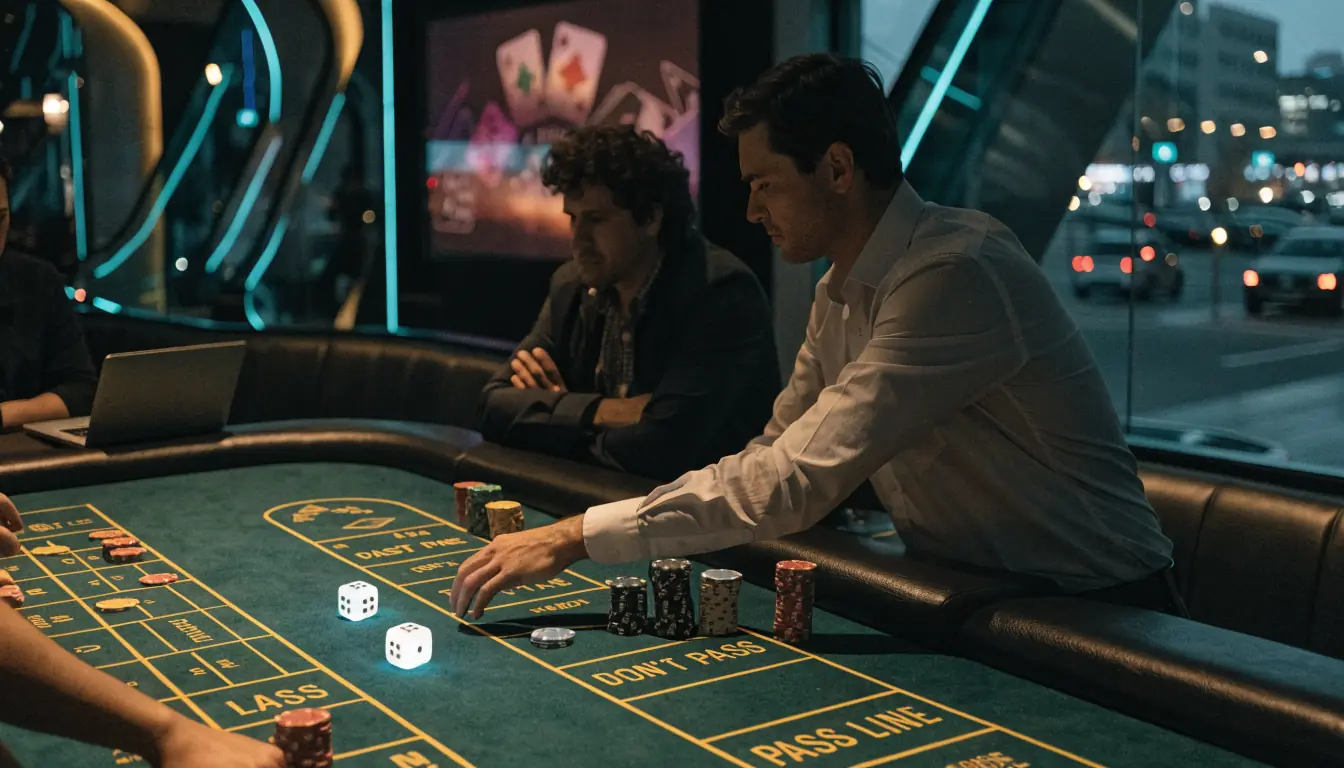
This is craps in its original form: a felt layout, a stickman calling the rolls, a boxman watching the chips, dealers paying out bets on either side. It’s a social, standing-up game, loud by casino standards, and it depends entirely on physical dice thrown by a player against a wall at the far end of the table.
How to play a physical craps round
Exchange cash with the dealer to receive chips you can wager.
Make your bet before the come‑out roll.
If a point is set, decide whether to add odds behind your line bet and continue betting until the shooter sevens out.
Land-based venues in Australia that run craps do so under state gambling law, with the table itself subject to the same physical-integrity rules as any other table game — supervised dice, marked layouts, pit staff trained to spot dice control attempts or short-stacking. None of this touches the Interactive Gambling Act 2001 at all, because nothing about it is "interactive" in the sense the Act cares about. It’s a table on a floor. The law that governs online gambling has nothing to say about it.
Live-dealer craps
This is where things get more interesting, and where a lot of marketing gets deliberately vague. Live-dealer craps streams a real table — real dealer, sometimes real dice, sometimes a dice-throwing mechanism designed to satisfy fairness auditors — to a screen. It’s built to look like the floor game. The stickman patter, the chip stacks, the felt: all there, just behind a camera lens instead of in front of your body.
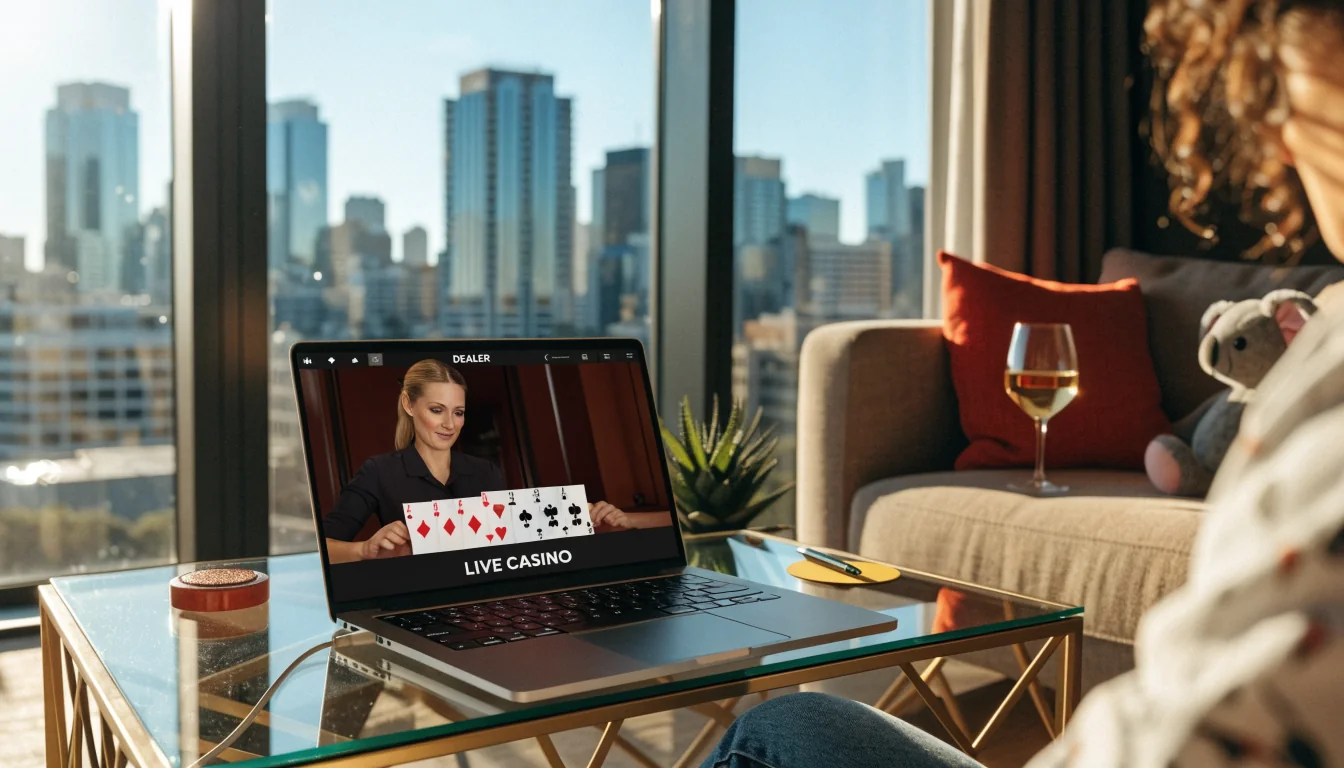
Functionally, though, it’s an online casino product delivered over the internet to a device. And that’s precisely the category the Interactive Gambling Act 2001 was written to restrict. The Act prohibits provision of online casino-style games — the law names slots, poker, blackjack and roulette explicitly, and craps sits in the same family of table games those provisions were designed to cover. I’ve seen this line get blurred in marketing copy that stresses the "live, real dealer" angle as if legitimacy comes from having a human on camera. It doesn’t. Whether the dealer is a person or a random number generator, the delivery channel — the internet, to an Australian resident — is what the law addresses. A live stream doesn’t step outside interactive gambling regulation; it’s still gambling delivered over an interactive service.
One caveat, and one that a fair number of players lean on without fully understanding it: the Interactive Gambling Act 2001 targets operators, not the individuals who play. It’s not illegal for an Australian resident to play at an offshore-licensed casino offering live-dealer craps. What’s illegal is offering that casino product to Australian residents in the first place — and it’s illegal to obtain a domestic licence to run one. So the live-dealer table you find on an offshore site is operating in a grey zone from the operator’s side, licensed somewhere else — Malta, the UK, a Pacific jurisdiction — and reachable from Australia because enforcement runs into the same border problem all internet gambling regulation runs into.
Electronic and RNG craps
The third format drops the human element entirely. No dealer, no live stream, just a screen simulating dice rolls through a random number generator, with the same bet types — pass line, don’t pass, field, hardways — laid out as clickable buttons instead of chips on felt.
This is unambiguously the kind of product the IGA was built to stop reaching Australian residents. It’s software, delivered online, simulating a casino table game for real money. There’s no physical component, no jurisdictional argument about "just a live camera feed from overseas" — it’s a straightforward electronic casino game, and it falls under the same prohibition as any online slot or virtual roulette wheel. I go into what that means for actually playing it for money in the next section, because the legal mechanics there are worth their own space rather than a paragraph here.
Illegal Offering
Providing real‑money online craps to Australian residents breaches the Interactive Gambling Act and can result in enforcement action.
A discrepancy worth naming plainly
Two different pieces of legislation get cited for this prohibition, and they don’t say the same thing. Some sources point to the Interactive Gambling Act 1997 as the law prohibiting online casino games for Australian residents; the more commonly cited and current reference is the Interactive Gambling Act 2001. I’m not going to pretend one of these is obviously right and quietly drop the other — the sources disagree, and readers deserve to know that rather than have it smoothed over. What both versions agree on, regardless of which year is attached to the name, is the substance: providing online casino-style games — including table games in the craps family — to Australian residents is prohibited, and no domestic licence exists to make it otherwise.
Where state regulators run out of road
It’s tempting to assume that if the Commonwealth has a law against something, someone locally is out there enforcing it table by table, site by site. That’s not really how it plays out with craps specifically, or with electronic table games generally. Bodies like the Victorian Gambling and Casino Control Commission or Liquor & Gaming NSW have real teeth over licensed operators within their own state — land-based casinos, wagering providers registered in that jurisdiction. Against an offshore site running live-dealer or RNG craps from a server sitting in another country, their power is limited. State regulators weren’t built with cross-border enforcement in mind, and that gap is exactly the space offshore operators occupy.
The Australian Communications and Media Authority handles the federal side, going after the sites themselves and the infrastructure that connects Australian users to them, rather than chasing individual state licensing breaches. But that’s a story about enforcement mechanics, and it belongs more fully in the landscape section than repeated here.
What actually varies between formats, and what doesn’t
It’s worth being honest about where the real differences sit, because "variants" of craps can sound like it’s about rule sets — and it mostly isn’t.
| Format | Where you find it | Legal treatment |
|---|---|---|
| Table game on the casino floor | Land-based venues | State gambling law, not the IGA |
| Live-dealer craps, streamed | Offshore online casinos | Falls under IGA’s casino-game prohibition for operators |
| Electronic/RNG craps | Offshore online casinos, apps | Same prohibition; no dealer, no camera feed |
The bet structure — pass line, don’t pass, come, don’t come, field bets, place bets, the hardways — doesn’t meaningfully shift between these three. A hardway bet pays the same whether you’re standing at a table in a casino or clicking through an interface built to imitate one. What shifts is delivery, and delivery is what the law is built around. Rules of the game stay put; regulatory status moves entirely with the medium.
The "real dealer" framing, and why it doesn’t change much
Live-dealer craps gets marketed on the idea that it’s "just like being there," and in terms of visual presentation, that’s often true — same call-outs, same chip stacks, sometimes even a functioning dice-throwing rig rather than a shuffled RNG outcome dressed up with dealer footage. But "just like being there" is doing marketing work, not legal work. Once it’s delivered to a screen over the internet, it’s an interactive gambling service, full stop, regardless of how convincingly it mimics the floor.
Play safely on land‑based tables
Visiting a licensed casino floor lets you enjoy craps legally and under state regulation, with full consumer protections.
I’d treat any claim that a live-dealer table is somehow exempt or "different" from other online casino games with real suspicion. It isn’t. The category the IGA addresses is defined by how the game reaches the player, not by whether the outcome is generated by a spinning wheel, a camera, or a chip inside a machine.
What this means before you go looking further
None of this is a comment on whether craps itself is a fair or unfair game — the rules, the odds on different bets, the house edge structure, none of that changes based on format. What changes is whether the version in front of you is being offered to you legally by the operator, and whether a domestic licence for it could ever exist. It can’t, for either the live-dealer or electronic form. That single fact — no domestic real-money online casino licensing exists, for craps or anything else in that category — is the thread running under everything in this section, and it’s the one worth carrying into any conversation about actually placing a bet online.
Real‑Money Electronic Craps: Legal Status and Availability
Here’s the question that actually matters once someone decides they want to bet real cash on a dice roll from home: is electronic craps, bubble craps, any of it, actually legal in Australia the way online sports betting is?
No.
The law usually cited here is the Interactive Gambling Act 1997, which prohibits offering online casino games to Australian residents — though some sources date the relevant provisions to a 2001 version of the same Act. Either way, the substance doesn’t change: casino-style games are named directly in that prohibition, and the list is not vague. Slots, poker, blackjack, roulette. Craps sits in the same family — a table game run for real money on a screen, no different in legal terms from a virtual roulette wheel.
There’s no separate carve-out for craps because it uses dice instead of cards or a wheel. The Act doesn’t classify games by mechanism. It classifies them by whether they’re "casino-style" and offered interactively. Electronic craps, whether it’s a single-player RNG version or a bubble craps machine wrapped in software, qualifies.
What the law doesn’t touch is the player. The restriction sits on the operator’s side — offering the game is the offence, not placing a bet on it. That’s a distinction worth holding onto, because it explains why offshore platforms keep showing up in search results without anyone getting arrested for using them. It also means there’s no domestic licence that makes any of this above-board. None exists to check.
So the honest answer to "can I play craps for real money online" isn’t a workaround or a list of loopholes. It’s that the product itself — electronic, real-money, casino-style — falls outside what can legally be offered here. Anyone selling it as compliant is selling a contradiction.
How to Play Craps in an Australian Casino
Walk up to a physical table and the rules stop being an abstraction. A dealer sets the puck, a stickman calls the game, and bets go down on felt marked in ways no screen tutorial quite prepares you for.
The sequence itself is simple enough:
- Buy chips at the table, not the cashier — the dealer exchanges cash for you.
- Wait for a come-out roll and place a pass or don’t-pass bet before it happens.
- Once a point is set, add odds behind your line bet if you want better value.
- Keep betting round by round until the shooter sevens out.
The floor experience differs from anything electronic. There’s no RNG deciding outcomes, no autoplay, just dice, a crowd, and a pit boss watching. Crown Melbourne, the Southern Hemisphere’s largest casino, runs tables at a scale most venues can’t match, which makes it a reasonable place to learn by watching before betting.
One thing worth knowing: land-based casinos answer to state regulators and police, not to the federal body that polices online gambling. Different rulebook entirely. "Regulated" here means something specific — and it’s not the same word used for websites.