
Real Cash Online Pokies in Australia 2026: What to Know
 Available in AU
- Real Cash Casino Games: What’s Available and How They Work
- Real Cash Slots: Features, Payouts, and Crypto Integration
- Casino Apps That Pay Real Cash: Key Considerations
- Online Pokies for Real Cash in Australia 2026
- Low‑Deposit Real Cash Slots: $10 and No‑Deposit Options
- Real Cash Online Casinos and Slots: Licensing Landscape
- Understanding Real Cash Casinos in Australia
- Winning Real Cash on Free Slots: How It’s Possible
- Free Online Slots for Real Cash: Legal and Practical Aspects
- How to Win Real Cash with Online Casinos: Strategies and Requirements
Real Cash Casino Games: What’s Available and How They Work
No local casino licence exists for Australian residents, and the Interactive Gambling Act 2001 makes sure it stays that way — it stops Australian-licensed operators from offering these services in the first place. What it doesn’t do is chase the players. The law is written to target providers, not the person clicking play, and there’s no criminal penalty for an Australian accessing an offshore casino. That gap between what operators can’t do domestically and what players can do offshore is the whole reason this market exists the way it does.
Once you accept that the entire real-cash casino segment for Australians runs offshore, the practical question becomes what these platforms actually offer and how the money moves through them.
The game categories, not just slots
Real cash casino games split into a handful of distinct mechanics, and it’s worth separating them before getting into any single one:
- Table games — blackjack, baccarat, roulette. Fixed rules, known odds, dealt either by software or a live dealer through video.
- Live dealer games — a real person running a real table, streamed to your screen. Slower pace, higher trust for players who don’t like trusting a random number generator they can’t see.
- Poker and poker-adjacent games — video poker sits closer to a slot mechanically, while multiplayer poker rooms are a different product entirely, closer to skill-against-other-players than betting against the house.
- Instant-win and specialty games — scratch cards, dice games, crash-style games. These are the ones built specifically for crypto rails, often running provably fair systems from the start rather than bolting them on later.
- Slots — the largest category by volume, but mechanically distinct enough that they get their own treatment separately.
Each category has its own payout logic. Table games pay against a fixed house edge you can calculate yourself. Slots pay against a programmed return figure baked into the software. Live dealer games pay exactly like their offline equivalents, just with a camera in between. Knowing which bucket a game sits in tells you what kind of "fair" you’re actually getting.
How the money side actually works
This is where crypto casinos changed the picture, and it’s not marketing — it’s plumbing. Bitcoin remains the currency most of these platforms accept by default, but the wider ones also take Ethereum, Litecoin, USDT, Dogecoin, Solana, Ripple, and a rotating list of altcoins depending on the operator.
Deposits on a crypto casino confirm fast — often within minutes, not the day-or-two wait that a bank transfer or card deposit might involve elsewhere. Withdrawals are usually just as quick, clearing in minutes with low fees when everything runs smoothly. But that "usually" is doing some work. Withdrawal speed also depends on the casino’s own approval process and how busy the blockchain is at that moment, and either one can slow things down regardless of what the marketing page promises. Two things are true at once here: the technology is fast, and the operator still sits in the middle of it deciding when to release funds. Worth knowing before you deposit anything you’d mind waiting on.

Where "fair" gets checked
The phrase "fair game" gets printed on every casino homepage. What it actually means, mechanically, is narrower than the phrase suggests. Reputable crypto casinos run on provably fair systems — cryptographic hashes generated before a bet that let a player verify, after the fact, that the outcome wasn’t altered. It’s a real check, not a slogan, but it only applies to platforms that implement it properly. A casino claiming to be "fair" without giving you a hash to verify is just using the word.
Where these operators are actually licensed
None of this runs on an Australian licence, because none can. What you’ll find instead is offshore licensing — Curacao and Malta are the two jurisdictions that come up most often among the operators serving this market. That’s a different regulatory standard than a domestic licence would be, and it’s worth treating it as such rather than assuming the word "licensed" means the same thing everywhere it appears.
Legal risk
Playing at offshore operators does not break Australian law for the player, but those operators are unregulated locally, meaning your funds have no domestic consumer protection.
What this means before picking a game
The range is wide — table games, live dealer, poker, instant-win formats, slots — and each runs on different mechanics with different ways of proving (or not proving) that the outcome was fair. The money moves through crypto rails that are fast on the deposit side and generally fast on the withdrawal side, with the caveat that the casino’s own processing can still be the bottleneck. None of it is illegal for an Australian player to access. What matters is understanding which category of game you’re playing, under which licence, before treating any of it as a straightforward transaction.
Real Cash Slots: Features, Payouts, and Crypto Integration
Slots get talked about as if they were one product. They aren’t. What sits behind the reels — the payment rail, the RNG audit, the way a bonus round is structured — changes what "playing for real cash" actually means. Most of the marketing copy skips that part. It’s easier to sell a spinning wheel than to explain how the money behind it moves.
What actually varies between slot titles
The features that matter for a real-money slot aren’t the animations. They’re the mechanics that decide how often and how much a spin returns, and how transparently that process can be checked. Bonus rounds — free spins, multipliers, cascading reels — are built into the game’s math model, not bolted on afterwards. A "generous bonus feature" is still bound by the same underlying payout logic as the base game. It changes the shape of the wins, not the long-run economics.


Where slots genuinely diverge is in how they’re verified. Reputable platforms run on RNGs that can be checked against a provably fair standard — not a marketing phrase, but a specific method: the game publishes a cryptographic hash before the round, and a player can confirm afterwards that the outcome wasn’t altered. This is more common on crypto-integrated slots than on traditional card-funded ones, mostly because the same blockchain infrastructure that handles the payment can also timestamp the proof.
Crypto’s actual role, not the pitch for it
Crypto casinos offer faster banking and more payment flexibility than card-led systems — that’s the practical case for them, and it’s a real one. Funds move directly between wallet and casino balance instead of through a card processor and its holds. That directness is also where most of the confusion starts.
The common mistakes are predictable once you’ve seen them a few times:
- Sending on the wrong network. A token sent on an unsupported chain doesn’t bounce back with a friendly error — it can simply be gone.
- Ignoring network fees. Deposits and withdrawals both carry a blockchain transaction cost that varies by network congestion, and players who don’t check it end up short on the amount that actually lands.
- Assuming crypto skips identity checks. It doesn’t, at least not at any operator taking compliance seriously. “No KYC” gets thrown around as a selling point, but on regulated or reputable platforms it usually means delayed verification, not none.
That third point deserves more weight than it usually gets. A few crypto casino platforms run on decentralized protocols where no single company holds the funds or decides the outcome — a genuinely different structure from a standard operator account. Others go further and issue native tokens with staking rewards and governance rights attached, though that detail comes from a single industry review rather than something verifiable across the market, and it’s worth treating as one operator’s feature set rather than a category standard.
The payout side nobody puts in the headline
Deposits on crypto rails tend to be fast. Withdrawals are where the story splits, and it’s worth saying plainly rather than picking a side: some platforms process withdrawals close to instantly, clearing in minutes with minimal fees; others hold withdrawals for manual approval before the blockchain even gets involved, and that review step — not the network — is what actually causes the wait. Anyone comparing "real cash" slot platforms on withdrawal speed is really comparing approval policies, not blockchain performance.
Withdrawal speed is not guaranteed by the blockchain alone; it also depends on the casino’s internal approval process, which can add delays.
What this means from an Australian account
None of this changes the legal position. The Interactive Gambling Act, enforced by the ACMA, prohibits unlicensed offshore operators from actively marketing online casino services — slots included — to people in Australia. It doesn’t touch the player side of a crypto slot session; the compliance burden sits with the operator, not the person spinning the reels.
Where it does bite is the payment layer. Amendments to the Act have aimed at stopping operators from accepting digital currency deposits from Australian residents, according to one industry summary of the changes — and separately, 2026 AML/CTF updates add reporting obligations that mostly land on providers rather than players. Two different things: one is about what a licensed Australian site can accept, the other is about what an operator has to report. Neither makes playing a crypto-funded slot illegal for the person doing it, but both explain why the operators mentioned as popular with Australian players — GoldEx, King Johnnie, Stellar Spins, per that same industry roundup — sit offshore rather than under a local licence. There isn’t one to hold.

The features are real. The payout speed is mostly real, with a caveat about approval delays. The crypto layer adds genuine flexibility and a verification method that’s harder to fake than a badge on a homepage. What it doesn’t add is a shortcut around identity checks or a workaround for where the operator is actually licensed.
Fast rail. Same rules.
Casino Apps That Pay Real Cash: Key Considerations
An app icon on a phone screen tells you nothing about who’s licensed to put it there. That’s the first thing worth sitting with before downloading anything promising a payout.
There are no domestically licensed real-money casino operators in Australia — not on desktop, not in an app store, not anywhere. The Interactive Gambling Act (the exact year cited varies between 1997 and 2001 depending on the source, but the substance is the same) prohibits offering online casino games to Australian residents. So a "casino app" that actually pays real cash to an Australian player is, by definition, running on offshore licensing. Curacao and Malta show up most often. That’s not a red flag by itself — it’s just the only structure available, since no local licence for this kind of product exists.
Offshore operators often use a Curacao licence; it provides basic regulatory oversight but limited player protection.
A Malta licence is considered stricter than Curacao, offering higher standards of fairness and security.
There is no domestic licence for online casino games in Australia; all real‑cash operators are offshore.
Why apps aren’t just smaller websites
A mobile app has to clear a different set of hurdles than a browser tab. Google and Apple both restrict real-money gambling apps in their stores for markets where the operator isn’t licensed locally — which, for Australia, is every offshore crypto casino. That’s why most of these platforms run as web apps: a mobile-optimised site you open through a browser and can save to your home screen, rather than something downloaded from an app store. It looks and behaves like a native app. It isn’t reviewed by a store, and it isn’t bound by store policy — only by the operator’s own terms and whatever jurisdiction licensed it.
That distinction matters for compliance. A desktop site and its "app" version are usually the same backend wearing different clothes. If the desktop platform requires identity verification before withdrawal, the app does too — going mobile doesn’t relax the checks, it just changes the interface they’re delivered through.
What actually determines payout
Whether an app "pays real cash" comes down to three things that have nothing to do with how polished the interface is:
- Licensing jurisdiction — determines what recourse exists if a withdrawal is delayed or disputed.
- Identity verification requirements — withdrawals are gated behind government-ID checks industry-wide; an app that skips this step isn’t cutting red tape, it’s skipping a safeguard.
- Payment rails supported — crypto deposits and withdrawals move faster than card transactions in most cases, but speed still depends on the operator’s own processing, not just the blockchain.
None of this is unique to apps. What changes on mobile is mostly friction: fewer taps to deposit, push notifications for bonus offers, biometric login instead of a password. The payout mechanics underneath are identical to the desktop version of the same platform.
The credit card and crypto question
One detail worth being precise about, because it gets blurred constantly: locally licensed Australian gambling platforms — the sports betting and lottery operators that legally serve this market — are barred from accepting credit cards or cryptocurrency for deposits. That restriction applies to the regulated Australian industry, not to offshore casino platforms, which sit outside that licensing regime entirely and set their own payment terms. Conflating the two is a common source of confusion in app reviews and forum threads.
Practical checks before trusting an app with a deposit
- Confirm the app is a mobile web version of a platform you can also verify on desktop — a standalone app with no corresponding site is a warning sign, not a convenience.
- Check whether ID verification is required before withdrawal, not just before deposit. If it isn’t mentioned anywhere, that’s an omission worth noting, not a feature.
- Look for the operator’s licence number, usually in the footer. No licence disclosed, no way to check who’s actually responsible for the funds.
"Instant payout" in an app store description is marketing language. What it actually means, in every case worth trusting, is: verified identity, cleared funds, and a withdrawal that clears on the operator’s schedule — not the app’s.
Online Pokies for Real Cash in Australia 2026
Choosing where to play real cash pokies in 2026 comes down to licensing, welcome offers and how quickly you can get your money out, so it pays to weigh these details before signing up.
License: Curacao Gaming Authority (Jumpman Gaming Ltd) · Bonus: up to A$6,600 + up to 250 free spins across 4 deposits Licensed under the Curacao Gaming Authority via Jumpman Gaming Ltd, this site pairs its credentials with a sizeable welcome package spread across four deposits, including a solid batch of free spins.
Bonus: 100% up to A$750 + 200 free spins, 35x wagering · Payout speed: crypto 30-120 minutes, fiat 24-72 hours · Min. deposit: A$30 This operator stands out for fast crypto payouts alongside a generous match bonus and free spins package, with a manageable minimum deposit for getting started.
License: Curacao OGL/2024/1335/0780 · Bonus: up to A$1,000 + 150 free spins, wager-free · Min. deposit: EUR 20 Holding a Curacao OGL license, this casino offers a wager-free bonus plus free spins, making its welcome offer straightforward and accessible with a low minimum deposit.
License: Curacao · Bonus: 100% up to A$500 + 200 free spins, 10x wagering · Payout speed: crypto 30-60 minutes, fiat 1-5 days · Min. deposit: A$10 Curacao licensed with a notably low wagering requirement on its welcome bonus, plus quick crypto withdrawals and a very low minimum deposit for new players.
License: Curacao – Antillephone N.V. (Versus Odds B.V.) · Bonus: up to EUR 2,000 across 5 deposits + 200 free spins · Min. deposit: EUR 20 Licensed through Antillephone N.V. in Curacao, this casino offers one of the more extended welcome packages, spread across five deposits with free spins included.
License: Curacao eGaming OGL/2024/923/0383 (Antillephone N.V.) · Bonus: up to A$2,000 + 100 free spins across 2 deposits · Min. deposit: A$30 Operating under a Curacao eGaming license via Antillephone N.V., this casino backs its offering with a two-deposit welcome bonus that includes free spins.
License: Curacao Gaming Control Board OGL/2023/176/0095 (Hollycorn N.V.) · Bonus: up to A$5,000 + 300 free spins across 4 deposits Licensed by the Curacao Gaming Control Board through Hollycorn N.V., this casino offers a large multi-deposit welcome bonus with a generous free spins allocation.
License: Curacao Gaming Control Board (TechSolutions Group N.V.) · Bonus: 100% up to A$250 + 100 free spins (1st deposit) Regulated by the Curacao Gaming Control Board via TechSolutions Group N.V., this casino keeps things simple with a straightforward first-deposit bonus paired with free spins.
License: Curacao Gaming Control Board OGL/2023/176/0095 (Hollycorn N.V.) · Bonus: up to A$11,000 + 300 free spins (code NEO100) Licensed by the Curacao Gaming Control Board through Hollycorn N.V., this casino offers one of the larger welcome bonuses on the list, activated via a bonus code alongside free spins.
Bonus: up to A$750 + 50 jackpot spins, 35x wagering · Payout speed: crypto ~90 minutes, fiat 1-5 days · Min. deposit: A$30 This casino combines a jackpot-spins bonus with fast crypto payout times and a moderate minimum deposit, giving newcomers a quick path into play.
Ask around any Australian gambling forum and someone will tell you pokies for real cash are illegal here. That’s not quite right, and the imprecision matters if you’re the one making decisions with your own money.
The Interactive Gambling Act 2001 doesn’t touch the player. It targets whoever offers the game. Slots, poker, blackjack, roulette — all of it sits under the same federal ban, but the ban is aimed at operators taking bets from Australian residents, not at Australians placing them. No licence exists domestically for real-money pokies, and none can be issued. That’s the gap "regulated Australian pokies site" tries to paper over: there isn’t one. It never existed and 2026 doesn’t change that.
So where does that leave someone in Sydney or Perth who wants to spin a real-cash pokie tonight?
What’s actually available
Nothing domestic. Every operator serving real-cash pokies to Australians is running offshore, licensed somewhere other than here, because that’s the only place a licence for this product can come from. Sports betting is a different story — state and territory licensing covers that, and it’s genuinely regulated on shore. Pokies aren’t sports betting. They fall under the same prohibition as the rest of the casino floor.
PayID unavailable
Offshore casinos cannot accept Australia’s PayID payment rail because it is tied to the local banking system, so deposits must use cards, e‑wallets, or crypto.
That means the pokies market Australians actually use in 2026 is entirely offshore by construction, not by choice or by shady dealing. It’s the only shape the market can legally take, given the law targets suppliers, not customers.
PayID, and why it won’t be on the pokies side
I’ve had people ask why PayID isn’t sitting next to the deposit button on offshore pokies sites the way it does on their banking app. It’s a domestic Australian payment rail, tied into the local banking system that offshore operators aren’t part of. Offshore platforms build around cards, e-wallets, and crypto rails instead — not because they’re dodging PayID specifically, but because it’s simply not part of the infrastructure they operate on. If a site claims PayID pokies with real cash, read that claim slowly before you believe it.
The "big red" pokies question
Certain pokie titles get asked about by name constantly, "big red" being one of them. I’m not going to pretend there’s a verified, sourced answer here about which offshore platforms carry it, under what terms, at what RTP. That information isn’t something I can confirm against anything solid, so I’m not going to dress up a guess as a fact. Anyone who states exact numbers on this without naming where those numbers came from is doing the same thing I’m refusing to do.
What actually changes year to year
Not the legal footing — that’s been stable since the Act came into force. What shifts is which offshore operators are active, which payment methods they support, and how aggressively they market to Australian traffic. None of that touches the core fact: no domestically licensed real-money pokies operator exists, and playing at an offshore one isn’t a criminal act for the player.
The bonus angle
"Real cash pokies bonus" gets searched constantly, and it’s worth being blunt about what that phrase usually hides. A bonus is a liability against your own deposit until its conditions are cleared. Wagering requirements should be visible before you accept anything, not discovered afterward in the terms page nobody reads. If a site won’t show you the requirement up front, that’s the answer already — walk.

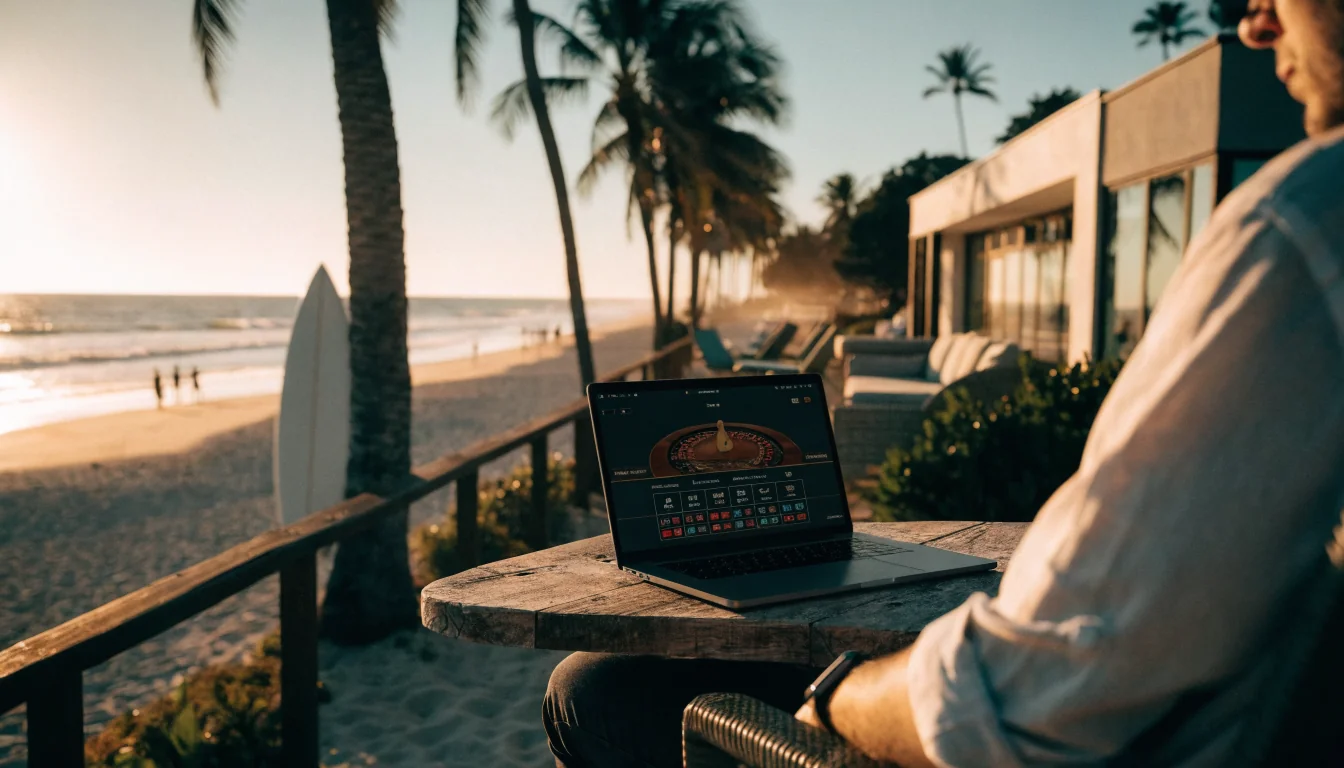
None of this is a case for or against playing. It’s the shape of the situation as it stands: offshore by structure, legal for the individual player to access, with no local licence and no local recourse if something goes wrong on the operator’s end. Decide with that in front of you, not with the vague version.
Low‑Deposit Real Cash Slots: $10 and No‑Deposit Options
A small deposit is where most players actually start, whatever the marketing suggests about high rollers and VIP tables. Ten dollars in crypto terms is a fraction of a coin, and that’s the point — it lets you test withdrawal speed and game behaviour before committing anything real. I’ve put in exactly that amount more than once, purely to see what happens on the way out, not the way in.
No‑deposit promotions work differently, and it’s worth being precise about what they are. A "free" balance handed out on signup is still the casino’s money until you clear whatever’s attached to it. Nothing about the word "no‑deposit" means "no conditions" — it means the deposit step is skipped, not the terms.
What a small deposit actually buys you
At $10, you’re not testing the game math — sample sizes that small tell you nothing about a slot’s real behaviour. What you are testing is the plumbing:
- Confirmation speed. Crypto deposits typically confirm within minutes, so a $10 deposit that’s still pending after that is a signal, not a coincidence.
- Withdrawal behaviour. This is where the two experiences I’ve had genuinely diverge — sometimes a withdrawal clears in minutes with minimal fees, and sometimes it sits waiting on casino approval before the blockchain does anything at all. Both happen. Neither is universal, and no casino will tell you upfront which one you’ll get.
- Identity checks. A small deposit doesn’t exempt you from verification at withdrawal. If anything, testing this early avoids a surprise later when the amount at stake is larger.
No‑deposit offers, read plainly
The no‑deposit bonus exists to get an account opened, not to give money away. It’s a customer acquisition cost dressed up as generosity. That’s not a criticism — it’s just what it is, and treating it as anything else sets up disappointment at the withdrawal stage, where the real terms surface.
None of this changes anything about where you’re playing from. Australian residents using offshore crypto casinos for small-stakes testing aren’t breaching the Interactive Gambling Act 2001 by doing so — the Act is written to restrict the providers offering these services into Australia, not the individual placing a $10 deposit. There’s no criminal exposure on the player’s side. That doesn’t make every offshore operator trustworthy; it just means the low-stakes test itself isn’t the legal risk.
A practical way to use the small amount
Don’t treat $10 as a bet — treat it as a diagnostic. Deposit it, play briefly, then request a withdrawal regardless of the balance. What you learn from that single cycle — confirmation time, whether ID is requested, how long the payout actually takes — tells you more about the casino than any amount of reading its homepage.
Small stakes, real answers.
Real Cash Online Casinos and Slots: Licensing Landscape
No real cash online casino operating today is licensed in Australia. That’s not a gap waiting to be filled — it’s the law. There is no domestic licence for online slots, roulette, or blackjack, and none is coming. What exists instead is a patchwork of offshore licences, mostly issued out of Curacao and Malta, sitting under casinos and slot sites that Australian players reach anyway.
That offshore structure explains a lot about how these platforms behave. A Curacao or Malta licence regulates the operator’s relationship with its licensing body, not with Australia. It’s a real licence, in the sense that it exists and imposes obligations — but "regulated" here means regulated somewhere else. Worth knowing before anyone treats a licence badge in a footer as a local safety mark. It isn’t one, because there’s no local mark to be.
What the Interactive Gambling Act actually targets
The Interactive Gambling Act, enforced by the ACMA, is aimed at operators, not at the games themselves in isolation. It prohibits unlicensed offshore providers from actively offering online casino services to people in Australia. In practice, enforcement has focused on the supply side — the businesses running the sites — rather than chasing individual accounts.
Payments are where the law has moved most visibly. According to one industry review of the amendments, the 2023 changes to the Act aimed to restrict operators from accepting digital currency payments from Australian customers. A separate account of the same reform states that in June 2024 the Act was amended to prohibit cryptocurrencies and credit cards on Australian-licensed gambling sites specifically. Those two versions don’t fully agree on scope and timing, and neither is something to treat as settled market practice — they describe an operator-side compliance shift, not a consumer rulebook.
What both versions agree on: the restriction sits on the licensed, local side of the industry — sports and racing betting, lotteries, the products that can legally carry an Australian licence. Offshore casino and slot operators are outside that licensed perimeter entirely, which is precisely why they can still take crypto deposits without touching Australian payment law.
Two licensing worlds, not one
| Local Australian licence | Offshore licence (Curacao, Malta) | |
|---|---|---|
| Applies to | Sports betting, racing, lotteries | Casino games, slots, poker |
| Payment rules | Crypto and credit cards restricted | Set by the issuing jurisdiction |
| Regulator | ACMA | Foreign licensing authority |
The takeaway isn’t "pick the properly regulated option," because for real cash slots there isn’t a locally regulated option to pick. It’s understanding which rulebook actually governs the site in front of you — and knowing that a licence number in small print tells you where a company is accountable, not whether it’s accountable to anyone in Australia.
Understanding Real Cash Casinos in Australia
A real cash casino, stripped of the marketing gloss, is a site where money moves in both directions: you deposit something with actual value and, if the outcome favours you, you withdraw something with actual value. That sounds obvious until you spend time in the industry and see how many products blur that line on purpose — "social casinos" that pay out in coins redeemable for nothing, or sweepstakes models that dress up the same slot library in different legal clothing. None of that is what Australian players mean when they search for real cash play. They mean: put money in, take money out.

For Australian users specifically, that money-in-money-out loop almost always runs through an offshore platform, because no domestically licensed operator offers it. The casino itself sits under a licence from somewhere else — Curacao, Malta, sometimes a jurisdiction most players couldn’t place on a map. What matters isn’t the flag on the licence, it’s whether the site pays and how it verifies the games are straight.
That second point is where crypto-based platforms have actually improved the picture. Reputable crypto casinos use provably fair algorithms — cryptographic hashes players can check themselves to confirm a spin or a hand wasn’t rigged after the fact. It’s not a guarantee of good faith, but it’s a genuine technical improvement over "trust us."
What actually separates a real cash casino from the rest
- Funds have external value. Currency or crypto in, currency or crypto out — not points, not credits capped inside an app.
- Withdrawals are tested, not promised. A site’s marketing page means nothing until money has actually left it.
- Fairness is checkable. Provably fair systems let you verify a result instead of taking the operator’s word.
By one industry roundup’s account, names like GoldEx and King Johnnie come up often in this space, alongside other crypto-friendly brands — though that’s one source’s list, not a market standard, and it changes as operators enter and exit.
There’s also a compliance layer most players never see. According to one industry overview, gambling providers are facing extra reporting obligations under 2026 AML/CTF changes — a shift aimed at operators, not at the people placing bets. It’s worth knowing it exists, mostly because it explains why some sites suddenly ask for more identity information than they used to.
Real cash, in the end, is a narrow claim. It doesn’t tell you a site is licensed for Australian players — it isn’t, none are — only that the money involved is real on both ends.
Winning Real Cash on Free Slots: How It’s Possible
"Free" is doing a lot of work in that phrase. It doesn’t mean the money disappears from the equation — it means someone else fronts the entry cost. There are really two separate mechanics that let a free spin turn into an actual payout, and they get conflated constantly.
The first is the promotional model: a platform gives out free spins or free-play credit as a marketing cost, and any winnings from that credit convert into withdrawable funds once the attached conditions are met. The spin itself costs the player nothing, but the win is real and lands in a real balance. This is the version most people mean when they ask how free slots pay out.
The second mechanic is less familiar and comes out of the crypto side of the industry. Some platforms run on decentralized protocols where no single company holds the funds or decides the outcome — the smart contract does both. On a few of these platforms, the native token isn’t just currency; it carries staking rewards and governance rights, according to one industry review of how these setups are structured. Stake the token, and you can earn on it independently of whether you’re actively spinning at all. That’s not "winning" in the conventional sense — it’s yield layered on top of a gambling product — but it’s another route by which a free-tier player ends up with real value attached to an account that started at zero.
What both mechanics share is a condition sitting between the spin and the withdrawal. Neither hands over cash the moment a symbol lines up. Read what that condition actually is before assuming a win is the same as a payout.

Free Online Slots for Real Cash: Legal and Practical Aspects
"Free" is the word doing all the marketing work here, and it rarely means what it implies. A free slot session that pays out real cash is still real-money gambling — it’s just structured so the entry point looks costless. Somewhere along the line you’re either wagering a bonus balance with strings attached, or the "free" version is a demo that never touches real money at all. Two different products, one shared label.
Legally, this sits in the same territory as any other online casino activity. Certain forms of online gambling are legal in Australia, but that legality is narrow and specific — it doesn’t stretch to cover locally licensed online casino games. Australia runs some of the strictest online gambling laws among developed countries, and no amount of rebranding a slot as "free" changes which side of that line the underlying activity falls on.

Practically, the question isn’t whether the spins are free. It’s what happens the moment a balance turns into a withdrawal request. That’s where the real terms live — verification, eligible payment methods, whatever conversion rule sits between the free credits and actual cash. None of that gets written on the landing page. It gets written in the account settings, after signup.
How to Win Real Cash with Online Casinos: Strategies and Requirements
There’s no strategy that beats the math behind a real-money game. What actually moves outcomes are the requirements you meet before a payout ever gets discussed.
Identity verification comes first. Every legitimate operator asks for government-issued ID before releasing a withdrawal, no exceptions, no shortcuts. Skip this step and the win sits frozen, no matter how it happened.
Reading bonus terms before opting in matters more than any betting pattern. Wagering conditions need to be visible up front — if they aren’t, that’s the answer already.
Age is not negotiable. The minimum is 18, checked at signup and again at cash-out.
Provably fair games let you check that a result wasn’t rigged after the fact — worth using, not worth obsessing over.
One legal point sits underneath all of this: sources disagree on which version of the Interactive Gambling Act applies here, the 1997 original or the 2001 update, but both point the same direction — the law targets operators offering services, not players placing bets. That hasn’t changed with any strategy discussion above.
Play within what you can afford to lose. Everything else is detail.
Are crypto casinos legal in Australia in 2026?
Yes, for players — the Interactive Gambling Act targets operators, not individuals, and there is no criminal penalty for Australians accessing offshore crypto casinos. However, no operator can hold an Australian licence for online casino games, so all platforms serving Australians run on offshore licences.
Is online casino legal in Australia?
No, offering online casino games such as slots, poker, blackjack and roulette is prohibited domestically, and no Australian online casino licence exists. Only forms like licensed online sports betting are legal, and individual players are not penalised for using offshore casinos.
What are the risks of crypto gambling?
Common mistakes include sending funds on the wrong blockchain, overlooking transaction fees, and assuming crypto removes identity checks. Also, offshore licences (e.g. Curacao or Malta) mean a different regulatory standard than a domestic one, and withdrawal speed still depends on the casino’s own approval process.
What cryptocurrencies do casinos accept?
Bitcoin is the most widely accepted, and many crypto casinos also support Ethereum, Litecoin, USDT, Dogecoin, Solana, Ripple and other altcoins.
How fast are crypto withdrawals?
Usually instant or processed within hours, often clearing in minutes with low fees. The actual speed still depends on the casino’s approval process and how busy the blockchain is at that moment.
What does RTP mean in pokies?
RTP is the programmed return figure built into the slot’s software — the payout logic the game pays against, rather than the fixed house edge of table games.
What is provably fair gaming?
It’s a system where the casino generates cryptographic hashes before a bet, letting you verify after the fact that the outcome wasn’t altered. A casino claiming to be ‘fair’ without giving you a hash to verify is just using the word.
Published by the Casino Features Guide team.